
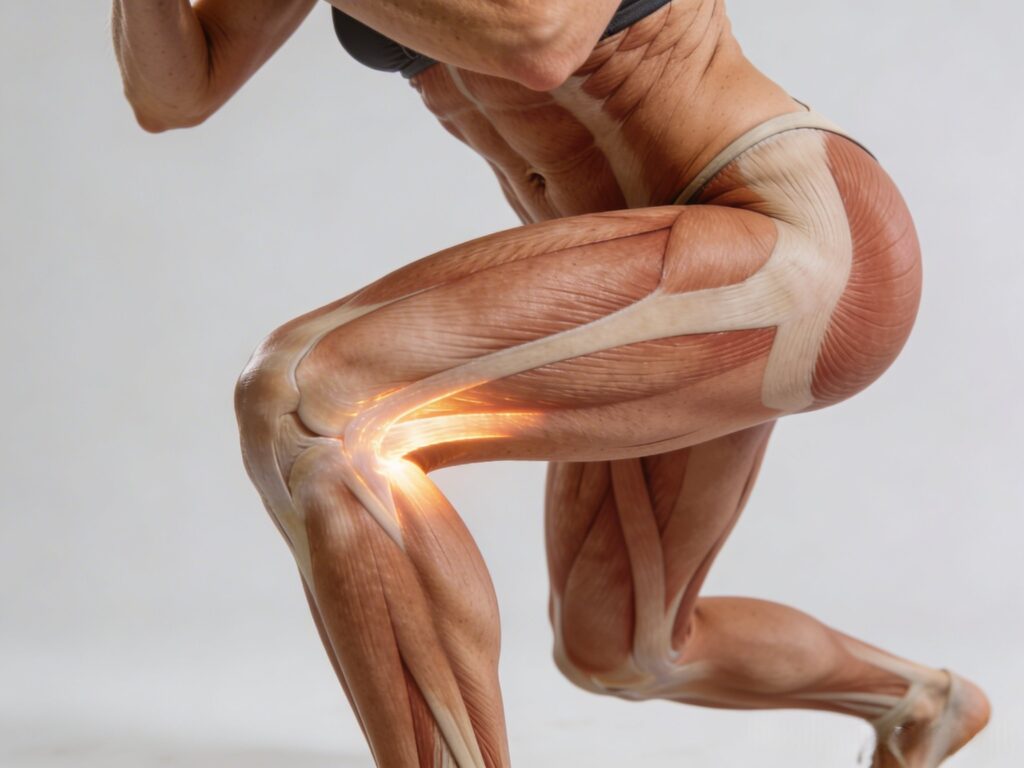
As we get older, many of us quietly accept feeling weaker, slower, and more fragile. We chalk it up to “just aging.” But research now shows that a specific way of exercising can actually reverse some of the physical effects of aging in just a few weeks—especially when it comes to muscle loss.
This article breaks down:
- What age-related muscle loss (sarcopenia) is
- Why it’s such a big deal after 50
- The “gold standard” approach to reversing it
- The top 5 science-backed exercises to stay strong, mobile, and independent
The Silent Muscle Thief: What Is Sarcopenia?
In 1989, scientists introduced the term sarcopenia—from the Greek sarx (flesh) and penia (loss)—to describe age-related muscle decline that begins as early as our 30s.
What they didn’t fully grasp back then was how fast this loss accelerates after age 50.
By 2019, sarcopenia was officially recognized as a medical condition because of how strongly it’s linked to:
- Frailty
- Disability
- Loss of independence
- Increased risk of falls and fractures
The more muscle we lose, the harder it becomes to do everyday tasks: getting out of a chair, climbing stairs, carrying groceries, or even walking for longer periods.
The Good News: Muscle Loss Is Reversible
Recent research, including a major study published in 2024, shows that sarcopenia is not inevitable. With the right type of exercise, older adults can regain muscle mass and strength in as little as 12 weeks.
However, there’s a catch: not all exercise is equally effective.
Randomly doing light stretches, slow walks, or improper strength exercises may:
- Waste your time
- Fail to build meaningful strength
- Even lead to injury if done incorrectly
That’s why the approach you take matters just as much as the exercises themselves.
The Gold Standard: Progressive Strength Training
The most effective method for fighting muscle loss is something called progressive strength training.
In simple terms, that means:
Start at a level that feels doable, then gradually increase the difficulty over time—either by adding reps, sets, weight, or complexity.
A helpful rule to follow is the “Golden Rule of Rehab”:
Consistency is better than intensity.
Think marathon, not sprint.
Instead of pushing yourself to exhaustion once in a while, you’ll make far more progress by doing the right exercises regularly and increasing them gradually.
A Real-Life Example: Adrian’s Story
Take Adrian, a 60-year-old who loved gardening and playing with his grandkids. After injuring his back, he struggled to walk even to his mailbox and could no longer enjoy the activities he loved.
When he started rehab:
- He could only walk for 10 minutes.
- He was given a few targeted exercises, including squats.
- He also started walking just 5 minutes a day.
Here’s the “trick” that changed everything:
Adrian was asked to increase his exercise and walking time by about 20% each week.
No drastic jumps. No pushing to the point of pain. Just consistent, gradual progress.
Within two months, he:
- Tripled his walking time
- Returned to gardening for an hour
- Gained the strength to lift and play with his granddaughter again
That’s the power of progressive strength training.
The 5 Best Anti-Aging Exercises (Especially If You’re 50+)
The following exercises focus on the major muscle groups that keep you independent and active:
- Legs and glutes (for walking, climbing, standing up)
- Core and back (for posture, stability, and pain prevention)
- Upper body (for lifting, pushing, and carrying)
Each exercise includes easier and harder variations so you can tailor them to your fitness level.
Always listen to your body. If you have existing medical issues, pain, or injuries, it’s wise to consult a healthcare or fitness professional before starting a new routine.
Exercise 1: Squats – The Foundation of Functional Strength
If there’s one exercise almost everyone over 50 should learn to do correctly, it’s the squat.
Why Squats Matter
Squats strengthen:
- Glutes (butt muscles)
- Quadriceps (front of the thigh)
- Hamstrings (back of the thigh)
- Plus they engage your core and back
These muscles are essential for:
- Walking
- Climbing stairs
- Getting up from a chair or toilet
- Lifting objects safely
How to Do a Basic Squat
- Stand with your feet shoulder-width apart.
- Place your arms straight out in front of you or cross them over your chest.
- Inhale and bend your hips and knees together, as if sitting back into a chair.
- Keep your back straight and your chest gently lifted.
- Pause briefly at the lowest point that feels comfortable.
- Exhale as you push through your heels and stand back up, focusing on your glutes and thighs.
Start with 2 sets of 10 repetitions.
To Make It Easier
- Use a chair:
- Sit down slowly, then stand back up (with or without using the armrests).
- Focus on slow, controlled movement, not speed.
To Make It Harder
- Hold a 10–15 lb dumbbell or household object (like a filled water bottle) close to your chest.
- Increase the number of reps or sets as you get stronger.
Exercise 2: Modified Crunch – Building a Strong, Supportive Core
A strong core does much more than give you “abs”—it supports your spine, improves posture, and helps prevent back pain.
This modified crunch targets both:
- The rectus abdominis (the six-pack muscle)
- The deeper stabilizing muscles of your trunk and back
How to Do a Modified Crunch
- Lie on your back with your knees bent and feet flat on the floor or bed.
- Place your hands on your thighs.
- Gently pull your belly button down toward the floor, flattening your lower back. This is a small pelvic tilt.
- Inhale deeply.
- As you exhale, lift your shoulder blades off the floor, sliding your hands toward your knees.
- Hold briefly at the top, then lower back down slowly as you inhale.
Aim for 2 sets of 15 repetitions.
Helpful Tips
- If your neck is uncomfortable, place your hands lightly behind your head—but don’t pull with your neck.
- Focus on initiating the movement from your core, not your shoulders or head.
- Quality is more important than speed or quantity.
Easier Version
- Do a partial crunch, lifting your head and shoulders just 1–2 inches off the floor. You should still feel your core working.
Harder Version
- Lift a little higher.
- Place a weight on your chest.
- Increase the number of repetitions.
Exercise 3: Reverse Lunge – Strength, Balance, and Bone Health
Lunges are excellent for building:
- Strong legs and glutes
- Better balance
- A more stable core
Research shows they can help:
- Improve hip and knee joint health
- Increase bone density, lowering the risk of osteoporosis
The reverse lunge is often easier on the joints than a forward lunge, making it a great choice for many older adults.
How to Do a Reverse Lunge
- Stand tall with feet shoulder-width apart.
- Hold onto a chair or countertop in front of you for balance if needed.
- Keeping your back straight, take a big step backward with one foot.
- Bend both knees so that:
- Your front knee forms about a right angle.
- Your back knee moves toward the floor, staying on the toes.
- Imagine your head, back, and hips moving in a straight line downward.
- You don’t need to touch the floor—aim to stop about 3–5 cm (an inch or two) above it.
- Push through your front heel to return to standing.
- Repeat on the other side.
Aim for 1 set of 10 repetitions per leg to start.
Easier Version (If You Have Knee or Hip Pain)
- Do mini lunges, going only about 25% of the way down.
- Keep a chair or countertop within reach for extra support.
Harder Version
- Let go of the support.
- Hold a 10 lb dumbbell in each hand.
- Gradually go deeper and increase your reps.
Exercise 4: Modified Push-Up – Upper Body Power
Push-ups are one of the most efficient ways to strengthen your upper body:
- Chest
- Shoulders
- Triceps (back of the arms)
- Plus your core
This exercise helps with daily tasks like lifting, carrying, pushing doors, and even picking up grandchildren.
Kneeling Push-Up (Modified Version)
- Get on the floor on your hands and knees.
- Place your hands slightly wider than shoulder-width.
- Walk your knees back a little and form a straight line from your head to your knees.
- Bend your elbows and slowly lower your chest toward the floor.
- Stop just before your chest touches the ground.
- Push yourself back up to the starting position in a smooth, controlled motion.
Start with 2 sets of 10 repetitions.
Wall Push-Up (Easier Option)
If getting on the floor is difficult or you have shoulder limitations:
- Stand facing a wall with your feet about a foot away.
- Place your hands on the wall slightly wider than shoulder width.
- Bend your elbows and lean toward the wall, bringing your chest closer.
- Push back to the starting position.
To make this harder over time, move your feet farther from the wall or progress to a countertop push-up.
Full Push-Up (Advanced)
If you have good strength and mobility:
- Do the same movement as the kneeling push-up, but with your feet on the floor and your body in a straight line from head to heels.
- Keep your core tight to avoid sagging in the lower back.
Exercise 5: Glute Bridge – The Mobility Indicator
The glute bridge is one of the best indicators of functional strength and mobility well into your 70s, 80s, and beyond.
If you can comfortably do 10–20 repetitions, it’s a good sign that you have the strength you need for:
- Getting out of bed
- Standing up from chairs
- Walking and climbing stairs
Because of this, many clinicians recommend it as a regular part of a healthy aging routine.
How to Do a Glute Bridge
- Lie on your back with your knees bent and feet flat on the floor or bed, hip-width apart.
- Place your arms by your sides, palms facing down.
- Gently engage your core, pulling your belly button slightly down.
- Inhale.
- As you exhale, press through your heels and lift your hips off the floor.
- Squeeze your glutes at the top. Your body doesn’t have to form a perfect straight line—just go as high as is comfortable.
- Hold briefly, then slowly lower your hips back down with control.
Aim for 2 sets of 10 repetitions.
Easier Version
- First, practice just squeezing your glutes and lightly lifting your hips 1–2 inches off the floor.
- Gradually work toward higher lifts as you build strength.
Harder Version
- Try a single-leg bridge, lifting one leg while performing the movement.
- This significantly increases the challenge and activates your side glute stabilizers.
Two Key Tips for Adults Over 50
- Keep your core engaged to protect your lower back.
- Avoid over-arching—focus on a smooth, controlled lift rather than forcing your hips too high.
Putting It All Together
These five exercises target the muscles that matter most for staying strong, mobile, and independent as you age:
- Squats – foundational leg and core strength
- Modified crunches – core and spine support
- Reverse lunges – balance, leg strength, and bone health
- Modified push-ups – upper body and core power
- Glute bridges – mobility and functional strength
Combined with the progressive strength training approach—slow, steady increases in difficulty—they can help:
- Reverse age-related muscle loss
- Reduce the risk of falls
- Improve posture and joint health
- Restore confidence in movement
You don’t need to overhaul your life or train like an athlete. Start small. Stay consistent. Increase by just a little each week—like Adrian did.
Your body is far more capable of change than you might think, no matter your age.


